
















The new Exynos 2100 is here. The Galaxy S21 series of smartphones are the first ones to be using this new chipset that is made with their own 5nm lithography process, and since we have the Galaxy S21 Ultra, we – of course – have to talk about its performance.
But, we’ll also compare with last-generation smartphone chipsets. Particularly, against its own Exynos 990 to see how much it has improved against itself, and also the Snapdragon 865 just to see how much Exynos has gotten better against the competition.
And we should also mention that both the Snapdragon 865 and Exynos 990 are already in the market for a year or so – and they’re much more matured drivers and optimized by the developers.
So, let’s begin.
We’ll start off by talking about the specs first. The Galaxy S21 Ultra that we have here is equipped with the Exynos 2100 chipset and 12GB RAM version alongside 256GB of storage.
To compare against the Exynos 990, we have the Galaxy Note20 with 8GB RAM and 256GB of storage.
For the Snapdragon 865 phone, we have the Xiaomi Mi 10T Pro. This phone we have here comes with 8GB RAM and 128GB of storage. Alright, let’s begin the benchmarks.
3DMark Wild Life
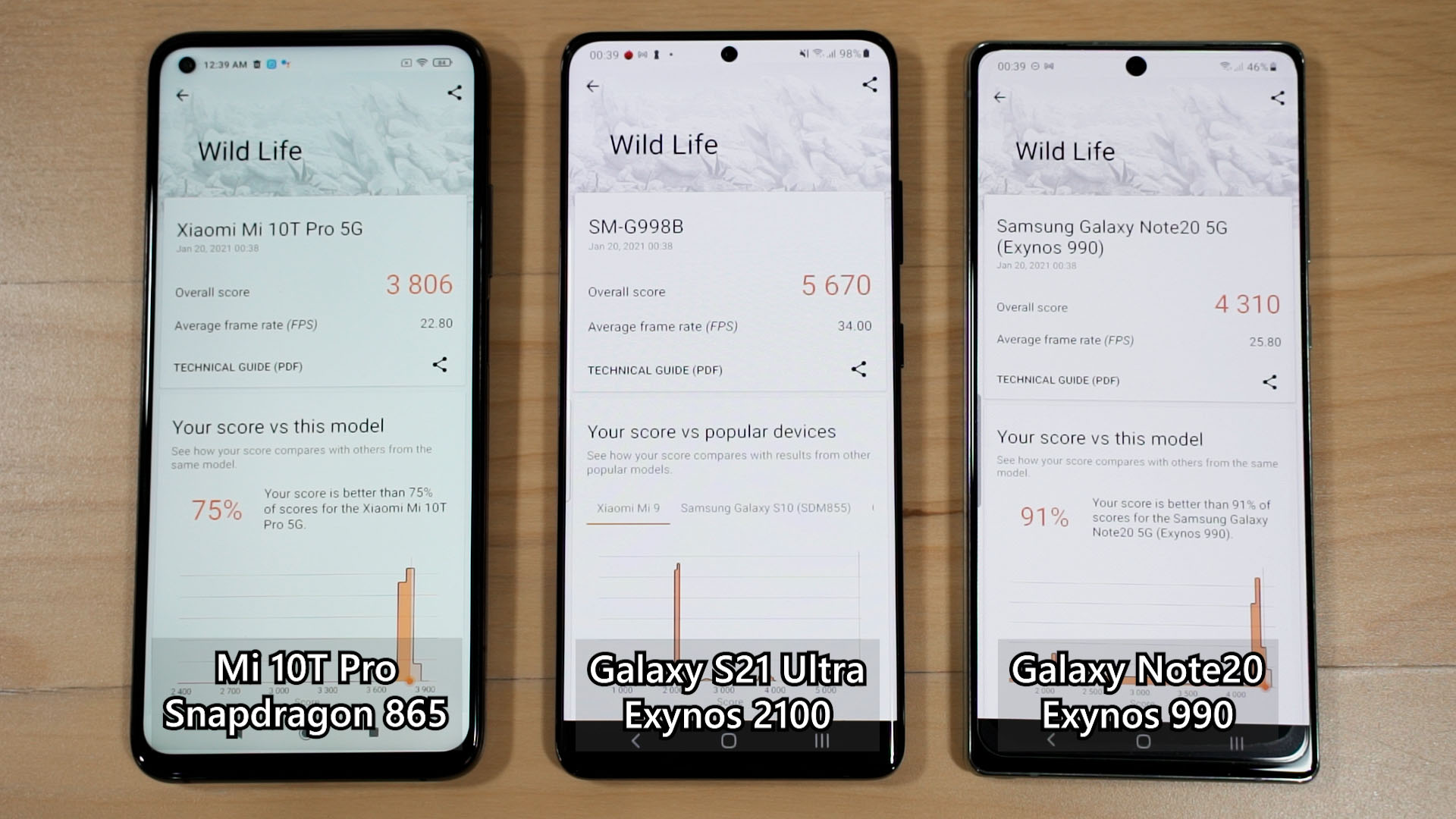
The first benchmark of choice is 3DMark’s new Wild Life benchmark. This is a new benchmark that uses Vulkan API and runs a minute and UL – the developers – claim that it has short-bursts of intense action like mobile games, and it also runs on 2560 × 1440 rendering resolution before scaling the content to the display.
Of course, the Exynos 2100 wins in this test.
3DMark Wild Life stress test
Then, we tried another test – by running the 3DMark Wild Life stress test. It runs 20 loops of the 3DMark Wild Life benchmark and this mimics how intensive games work – and from here, we can see the Exynos 2100 not being able to maintain the score across all 20 loops. Somewhere after 10 loops, the performance drops and maintains on a flatline.
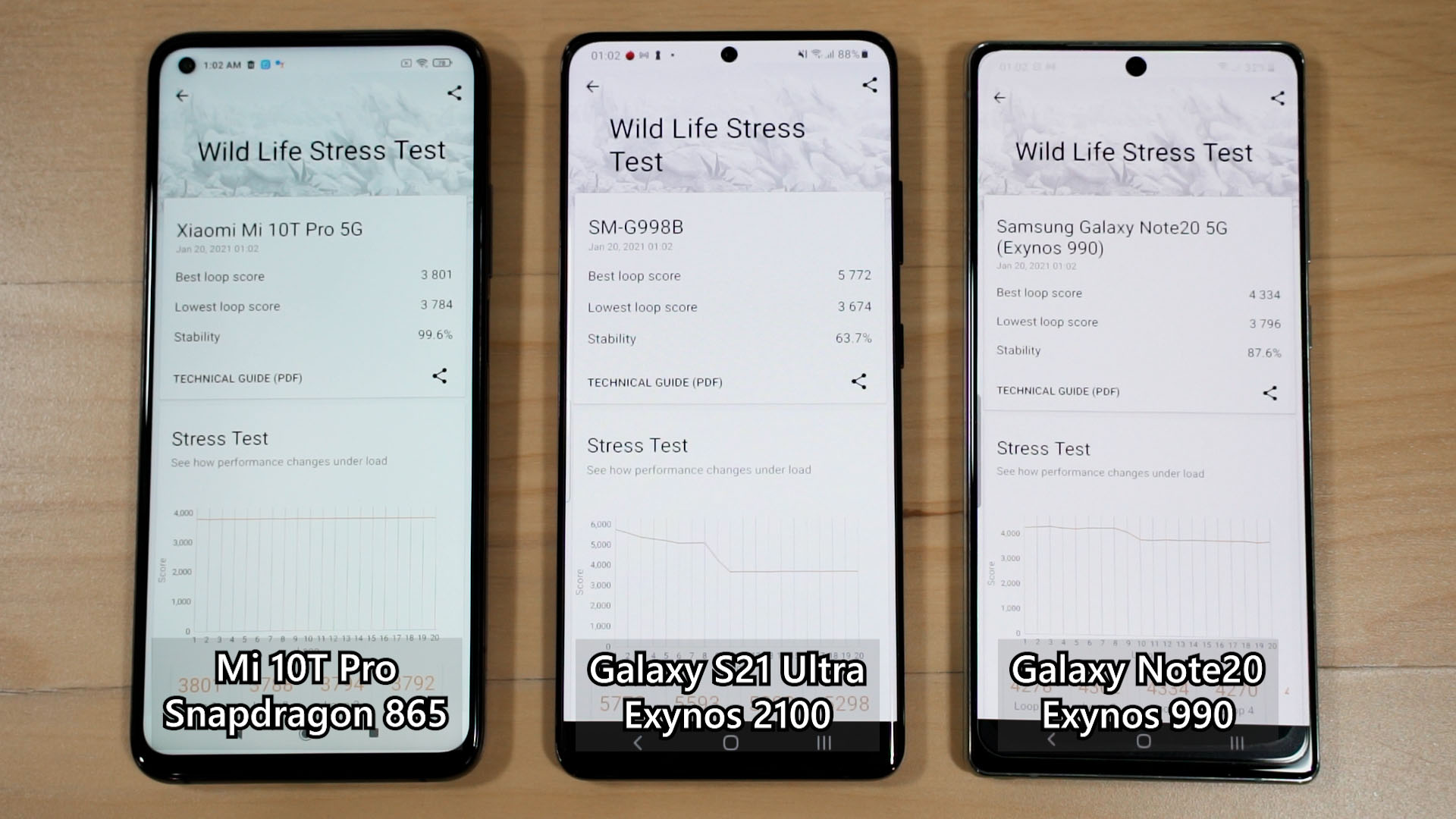
The graph suggests thermal throttling since it flatlined at the 10th loop, and the same thing happened between the S21 Ultra and the Note20. Perhaps there’s something else at play – and Antutu also suggests something different – but we’ll discuss later.
Geekbench CPU
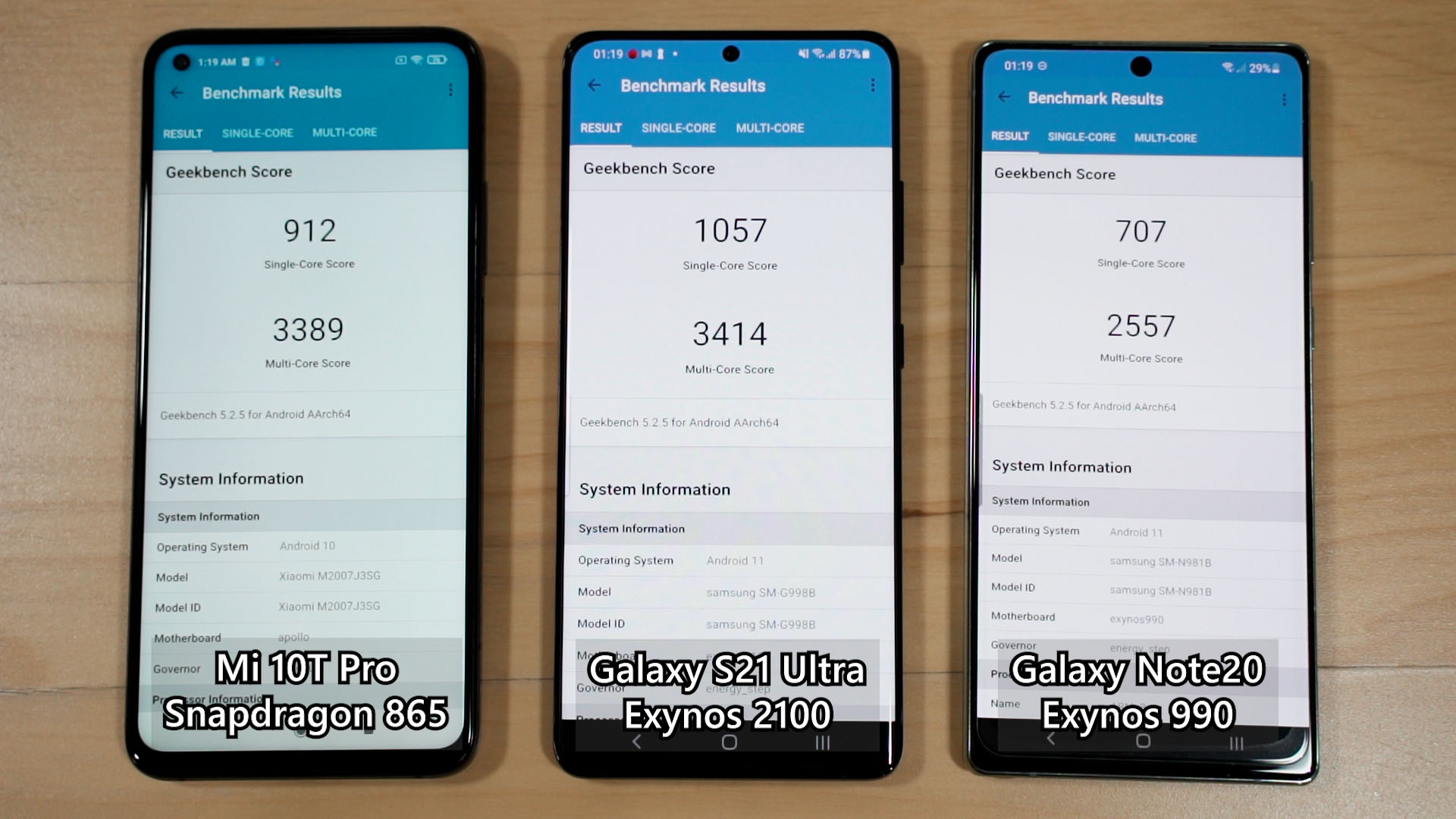
Then comes Geekbench – everyone’s favorite. This time, it’s really simple – the Exynos 2100 crushes both Snapdragon 865 and Exynos 990 chipsets. What’s interesting here is the massive improvements over the Exynos 990. In single-core performance, the Exynos 2100 is 1.5x better, and 1.33x better in multi-core performance.
Geekbench Compute
As for the Geekbench Compute using OpenCL – wow, the Exynos 2100 is just superb. More than double the score of the Snapdragon 865, and 1.3x better than the Exynos 990.

Antutu
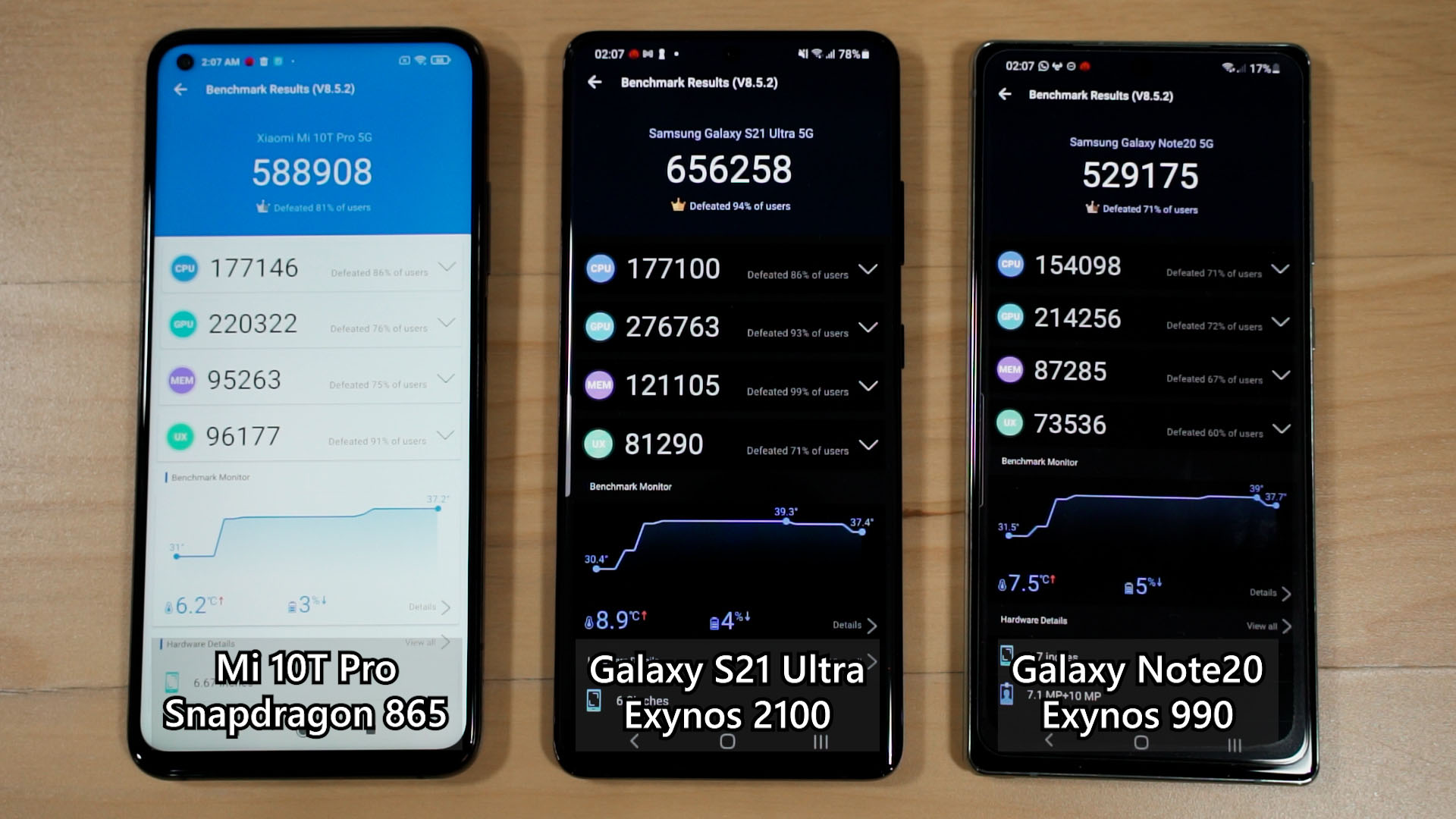
And lastly comes Antutu. The Antutu scores are very misleading since its overall score culminates multiple different aspects of a phone together. Sticking to the main topic of this video, we’re only going to focus on the chipsets alone – so we’ll isolate and compare both CPU and GPU only.

It is here that we can see that the Exynos 2100 trades blows in the CPU benchmarks with the Snapdragon 865, but when it comes to GPU – the new Mali-G78 MP14 GPU that’s in the Exynos 2100 is much better than the Adreno 650 inside the Snapdragon 860.
And back to the temperature part – as you can see, the temperature did rise, and it seems to have a phobia against hitting the 40°C mark, hence the performance flatlining on 3DMark Wild Life test.
Androbench
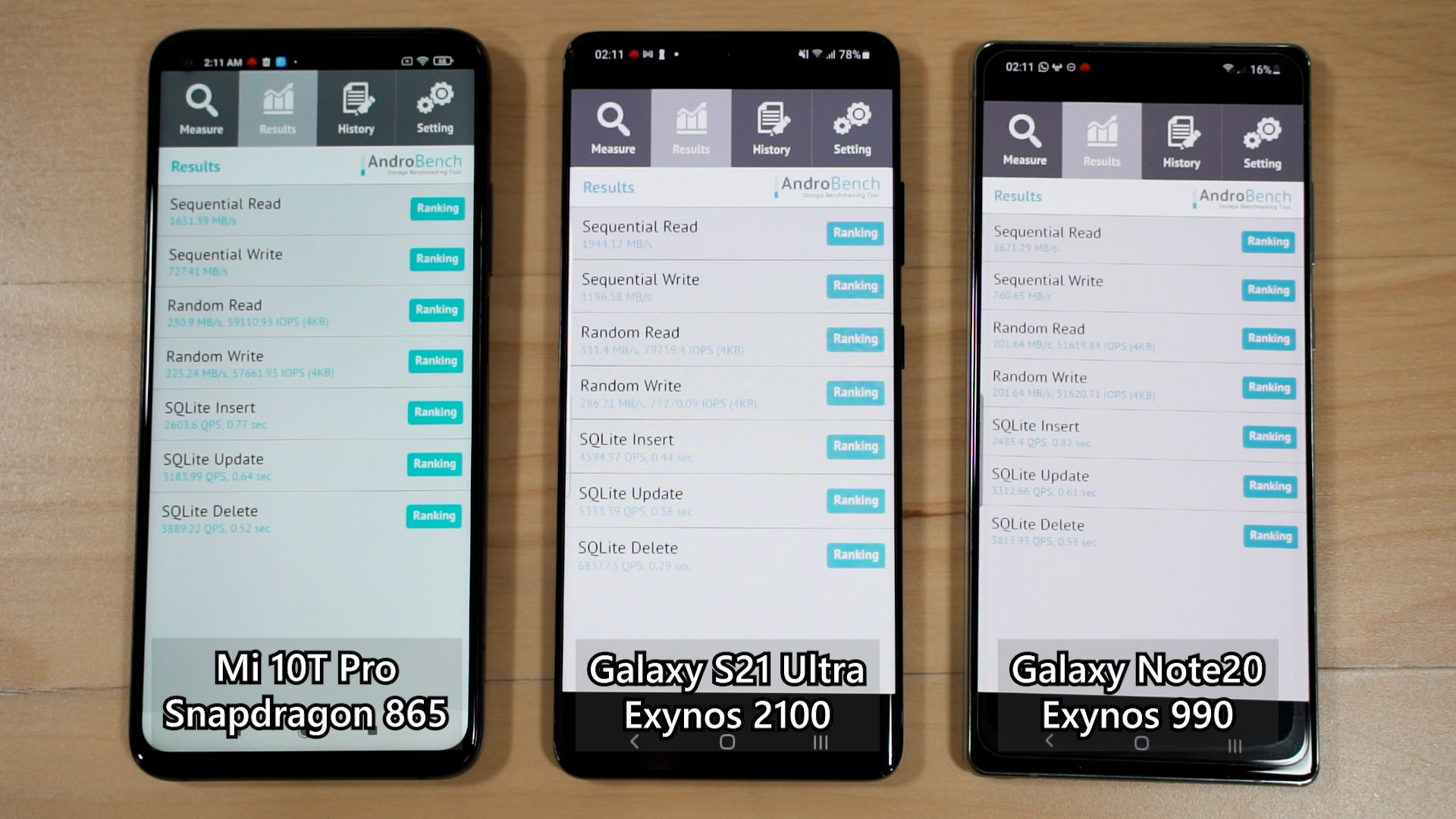
And as a quick bonus, benchmark for the storage speed test. All of these phones that we have here uses UFS 3.1 NAND flash chips, but the Mi 10T Pro and Note20 both has more or less the same speeds but the Galaxy S21 Ultra has much higher scores for the UFS 3.1 chip.
That’s it. The performance number will most likely change as more updates come out to optimize the performance of the Exynos 2100. While benchmarks do show the improvements in numbers, we also have yet another video showcasing the Galaxy S21 Ultra’s gaming performance. So, watch that instead.
Is Exynos back?
It’s difficult to say since we do not have a Snapdragon 888 smartphone to compare with. But from what we can see here, the new Exynos 2100 is showing a lot of promise.
Watch our full review of the Samsung Galaxy S21 Ultra too, where we talk about its chipset efficiency across multiple different refresh rates and resolutions alongside the 25W fast charging speeds. It’s surprisingly efficient in comparison with other phones!
Like our Facebook Page here at NasiLemakTech.com for more news and in-depth reviews! Also, join our Facebook Group for insightful information and memes!
Subscribe to our YouTube channel too!