













Let’s talk about what Nokia had gone through over the years. Back during the days when they’re still stuck with Symbian OS, things weren’t going so well. That’s when Apple first announced the iPhone and Android came out not too long after that. Around that time, the economic crisis hit. Things were nasty for Nokia. Then, Microsoft bought over the mobile division and that didn’t go well either. Now, they have returned under HMD Global – and is it ready to reclaim the throne with the Nokia 8?
Let’s take a deep look at the Nokia 8, and determine if it is worthy of your money.
Unboxing

Let’s take a look at the box itself. The Nokia 8 comes in a surprisingly dull box, in my opinion. It’s nothing special at all. One sealed square box. Opening the lid reveals the phone itself and beneath the phone are some of the documentation and accessories.

The compartment beside it is where the charger and cable are placed. Nicely packed, but rather lackluster.

The things Nokia has included within the Nokia 8 is of the usual – but they’re definitely of the best quality. Look at that USB-A to USB-C cable! It’s thick, and with that USB-A header color, it only signifies that the cable is compatible with USB 3.0 standards too.

There’s also a pretty good-looking pair of earphones, too.

Again, nothing out of the ordinary in terms of packaging design or langauge, in my opinion. A little too simplistic, actually.
[nextpage title=”Design”]
This is where things get interesting for the Nokia 8. Milled out of a single block of series 6000 aluminium, the Nokia 8 feels solid as heck. We made a joke together with Low from Tech Critter where we can destroy the world by knocking two Nokia 8s together.
And we here at Nasi Lemak Tech think that might just happen – not in such a catastrophic manner, of course. The Nokia 8 is really solid in the hands. Weighing in at 157 grams for a tinier-than-usual smartphone, it’s definitely because of the series 6000 aluminium’ density.

Its curves are made in such a manner that the volume rocker and power buttons are placed around the turning point – but it’s placed so well-designed that it’s easy to press yet its tactility is fantastic. You don’t have to worry about slipping and dropping the phone at all.

Then comes the navigation keys. For some reason, Nokia opted to go for a fingerprint-cum-home button design with two capacitive keys at flanking at each side.

I mean, it’s not like they don’t have space at the back. No sir. Just for some reason, Nokia decided not to go with a fingerprint sensor underneath the camera module instead. The Nokia 8 could’ve pretty much shrunken the chin a little and moved those buttons to go on-screen instead.
Why? Because they’re using an IPS LCD display. Which leads us nicely to the next segment…
[nextpage title=”Display”]
As mentioned, the Nokia 8 uses an IPS LCD display. A 5.3-inch 2560×1440 IPS LCD display, to be exact. Yes, it’s using a 5.3-inch display panel with 2K resolution.

Also, the Nokia 8 has something we call as “screensaver”, where it displays the time, day, date, missed calls, SMS, and emails (or whatever combination you like) when it’s in standby mode. Sounds a little like “always-on display”, right?

Pretty much, except that the Nokia 8 is pretty smart. As always-on displays only work well in terms of battery life for AMOLED-based displays, Nokia implemented a little timer where it’ll turn off the screensaver after some time (which you can set). Lifting the phone up will trigger the screensaver to show up again, and there’s an infrared sensor beneath the earpiece. Pretty smart, but it’s not really effective, in my opinion. I’d rather unlock the phone entirely and have a look instead.

Which brings me to my next point. Since it’s using IPS LCD display, it can use on-screen navigation buttons instead of having physical capacitive keys at the bottom. Then, the Nokia 8 could have a smaller, sleeker chin.

[nextpage title=”Connectivity”]
When it comes to connectivity, I think the Nokia 8 has nailed it down nicely. Comes with 802.11ac WiFi, NFC, and even Bluetooth 5.0. Consider the Nokia 8 as a little more futureproof when it comes to connectivity.

The Nokia 8 even has NFC!
Now, most of these features aren’t used to its fullest potential anyway, or either just not that effective. AC WiFi on phones isn’t really that useful other than to segregate and disperse the network traffic to prevent network chokes. I mean, if you’re going to transfer large amounts of data over WiFi, might as well do it through a laptop/desktop instead. NFC on the other hand, is a dying technology in general (other than some places like Japan, of course).
Bluetooth 5.0 is still scarce in the market, especially when it comes to compatible devices. The Samsung Galaxy S8, as shown in our review here, has a good use for it to mirror your audio stream to two different Bluetooth audio devices with the Dual Audio feature. A rather novel feature, but at least it’s there.

Then comes the SIM/microSD slot. The Nokia 8 comes with a standard SIM1 and SIM2/microSD combo. SIM1 takes in a nano-SIM card whereas the SIM2 slot takes on either a secondary nano-SIM card or a microSD card. Pretty simple.
Also, to note, the Nokia 8 does come with a USB-C 3.0 cable. That’s surprising, as only a select few of the highest end smartphones come with USB 3.0.
[nextpage title=”Camera”]
Let’s talk about the camera here. The biggest news that came out after the launch of Nokia 3, 5, and 6 this year is actually the return of Zeiss optics to Nokia smartphones. Everyone went crazy over it – and I’m one of them. I mean, back during Nokia’s glory days, their cameras were obviously much better. Can the same be said for now?

Well, let’s have a quick rundown on the Nokia 8’s camera specs.
- Rear-camera
- 13MP (color+OIS) + 13MP (monochrome) f/2.0 lens with PDAF, IR rangefinder
- Selfie camera
- 13MP f/2.0 with PDAF
I’m rather impressed that Nokia actually used opted for same aperture and sensor for each camera.
Dual-cameras on the rear
We’ve discussed what dual-cameras are all about here. The Nokia 8 is one of those smartphones that jumped onto the dual-camera hype, and it has opted for something similar to Huawei’s P10 series of smartphones. One camera for color, and another camera for monochrome.

I personally would prefer the dual-cameras to be one telephoto and another one to have somewhere around 25mm lens. But whatever, Nokia has opted for a stereoscopic dual-camera system instead.

Below here are the pictures were taken with the Nokia 8’s rear-camera(s). You can take pics using either the RGB sensor alone, the monochrome sensor alone, or both. I find that the picture produced by either the RGB sensor alone or both are pretty similar, so it’s quite redundant.



The Live Bokeh mode is seriously something to behold. Look at the image it can produce! Look at my hair!
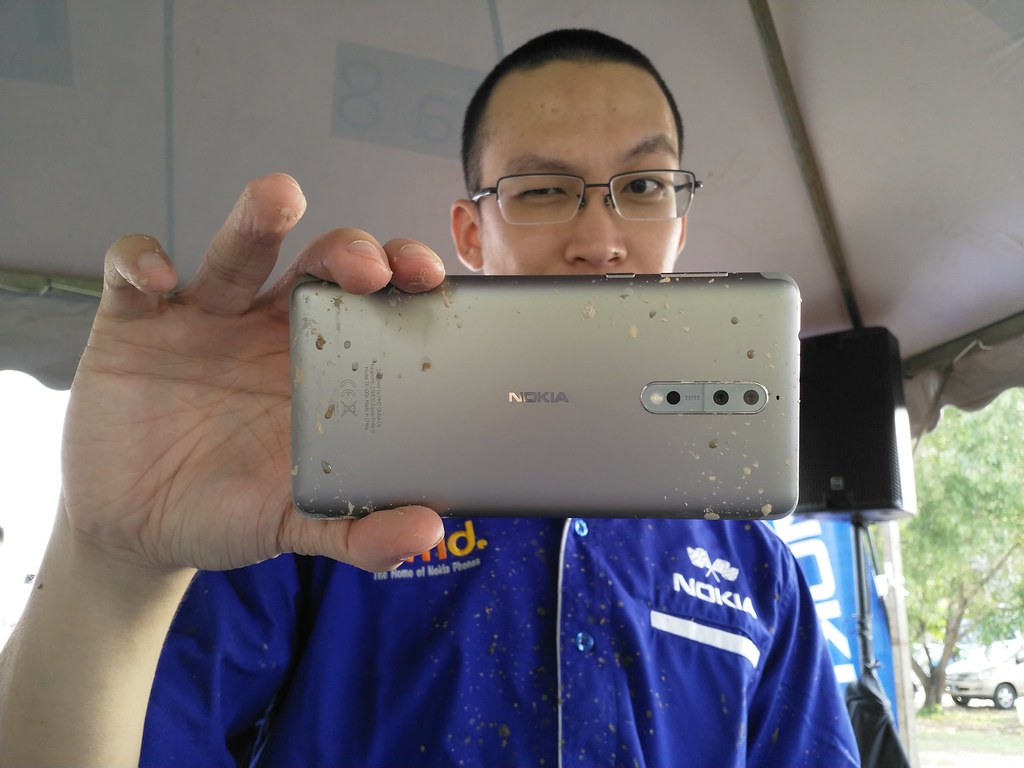
Yeah, that’s during the Nokia 8’s launch event. John Diew from My Everyday Tech rode the buggy on the muddy road (event was after a heavy rain) and mud just flew all over his review unit of the Nokia 8!

I rode the hot air balloon instead. Picture above is with HDR on, and the picture below is without HDR.

The difference is pretty stark.
Walking around Setia Walk, the umbrellas hanging around the walkway looks pretty colorful, so I whipped out the Nokia 8 and took a shot.

The colors that the Nokia 8 produces is pretty nice, too. Wish it has a little higher exposure, though.

Selfie camera
Here’s an interesting point to take note of – the Nokia 8 actually has an autofocusing selfie camera! This little feature isn’t found in many other flagship smartphones (not even selfie-centric smartphones like the ZenFone 4 Selfie Pro) – and I’m impressed that the Nokia 8 actually has it. Sure, it doesn’t have the fastest autofocusing technology, but it still takes sharp selfies which I’m all in for.
Other features
The Nokia 8 is a special little smartphone. It’s the first one to boast something that they’re dubbing it as Bothie. Which is to say that you can take a picture, video, or even live stream in a split-screen manner. Quite similar to what Samsung has done with the Galaxy S4’s “dual camera mode” back in the days but better. One half for the rear-camera, and another half for the selfie camera. You can, of course, swap them around across the halves whenever you like.
However, you can’t swap out of bothie mode once you’re in a live stream. That’s a bummer, since there’s not always something to show on your own side.
Also, one more thing about the Bothie mode – for some reason, the selfie camera is zoomed in by quite a lot. Take a look at some Bothies I took with the Nokia 8.

I mean, the Bothie is a noble feature. But I still have no idea why the selfie camera is zoomed. It’s awkward to see that in selfie mode I got my face framed nicely, but once I activated Bothie mode, it zoomed to my nostrils.
The Bothie mode can create some interesting photos too. I lifted the Nokia 8 up high on a road and took this photo. Shows us how far we’ve come, and how long more we have to go.

The main thing is the audio when it comes to the Nokia 8. With their brand new technology dubbed as OZO Audio. During that Bothie live stream, I’m rather impressed with the audio quality. Apologies for the stream quality, though. Not having good reception there, actually.
The camera UI on the other hand, will definitely need some improvement. It’s a little clunky at the moment, and some buttons are in positions that it’s not meant to be in.
[nextpage title=”Software”]
I have to say, for Nokia to opt for something that’s very close to vanilla Android is a good thing. That means updates will get pushed much faster than other heavily-customized versions of Android. Nokia is literally saving time and money while improving our security by delivering timely updates.
Nokia even announced that the Nokia 8 will be one of the first to get the upcoming Android 8.0 Oreo update!

The lack of any customization on vanilla Android is a double-edged sword. By default, there’s no option to display battery percentage number on the icon itself, and there’s no theme engine for vanilla Android as well. It looks… really bland, I should say.
Stock Android means you’ll be tied in with Google’s own suite of apps too. Nokia 8 doesn’t have any custom music player other than Google Play Music. There is no special picture gallery app other than Google Photos app. Of course, there’s an app for everything these days if you prefer something else.
Also, I’m surprised that Nokia made a separated CDFS partition for the Nokia 8 and pre-loaded an installer for the USB drivers.
 Which leads me nicely into the next section – custom ROMs and whatnot.
Hackability?
When it comes to smartphones, there’s always rooting, custom ROMs and custom recoveries swimming around in the depths of the internet.
For Nokia 8, it doesn’t seem like there are any rooting methods just yet. To be honest, I wonder if rooting Androids are still relevant these days. Many apps now don’t work if it detects that you’re rooted, too. Also, features on custom ROMs are integrated to stock Android so nicely that it makes custom ROMs feel like a burden.
Whichever the case may be, I think custom ROMs will come soon to the Nokia 8.
[nextpage title=”Performance”]
The Nokia 8 comes with the latest and greatest hardware that is available today. Here’s a quick rundown of its specs.
- Qualcomm Snapdragon 835 chipset
- Adreno 540 graphics
- 5.3-inch 1440p (2560×1440 pixel) IPS LCD display
- 4GB RAM LPPDDR4X
- 64GB storage
Let’s head on over to some benchmark scores.

With such high-end specs, it obviously crushed Epic Citadel. Topped off at 59FPS. Don’t worry about that last FPS, I saw the FPS counter jumping up to 62FPS sometimes.
Temperature isn’t an issue too. It got a little warm, but that’s it. The Nokia 8 didn’t get to a point where it felt uncomfortable. Thanks to the series 6000 aluminium unibody for superior heat dissipation, perhaps?
Onto Vellamo. The Nokia 8 seriously crushes the entire suite here. Sometimes I even wonder why we run such benchmarks when it doesn’t even translate to real life day-to-day usage. The Nokia 8 will run fine with whatever task you throw at it – period.

Though, there’s one interesting point to make about the Nokia 8. I discovered that the Nokia 8 is using Samsung’s storage chips – specifically, the KLUCG4J1ED-B0C1. This is Samsung’s UFS 2.1 memory chips. I was getting about 650MB/s sequential read speeds – and that raised my eyebrows.

Unlike the Huawei P10’s storage chip fiasco, the Nokia 8 comes with UFS 2.1 chips right out of the gate. You can expect super-speedy read and write speeds for the Nokia 8.
[nextpage title=”Battery”]
When it comes to battery life, the Snapdragon 835 coupled with Nokia’s software optimization, it’s actually pretty good.
With our standard battery life test on PCMark for Android, the results are actually quite stunning.

Ten hours and 35 minutes? That’s quite close to what the ASUS ZenFone 3 was getting! I’m seriously impressed by the score that the Nokia 8 obtained through this test – and it’s all thanks to the Snapdragon 835 chipset and FinFET.
Learn more about how FinFET affects battery life and performance here.
Charger
Now as for the charger, the Nokia 8 supports Qualcomm’s QuickCharge 3.0, and the charger that comes in the box does provide that power, too. The charger itself is rather big in size, but at least the Earth prong is collapsible. And the side USB port is a little weird, too.

This little charger is capable of outputting a total of 18 watts max – either though 9V at 2A or 12V at 1.5A.

Qualcomm’s QuickCharge 3.0 on the Nokia 8 is rather interesting. Take a look at it here.

It reaches from a mere 4% to 100% in about 2 hours’ time, but thanks to its nonlinear charging curve, it can actually charge up to 50% of battery at 35 minutes time. Pretty good.
[nextpage title=”Wrapping up the Nokia 8 review”]
The Nokia 8, priced at RM2,299, is indeed a one-of-a-kind smartphone. For those who seek a smartphone with flagship specs that is smaller than the minimum standard of 5.5-inch screen size, then the Nokia 8 is definitely on that list. I’m one of those who would actually like smartphones that are smaller than 5.5-inches.
Then comes the other aspects of the Nokia 8. In terms of connectivity, the Nokia 8 is top notch – no arguments about that. Milled out of a single block of series 6000 aluminium, the Nokia 8 feels very different compared to other smartphones in the market. One reason is that of its weight. Given its size, the Nokia 8 is a little weightier than expected. The aluminium unibody even helps to dissipate heat, as the Nokia 8 rarely ever feels warm during intensive usage.

Its cameras, however, will need a little improvement – particularly on the UI side. There are buttons going to places where it shouldn’t suppose to be. On a side note as a personal preference, I would really prefer the Nokia 8 to be using a hybrid dual-camera system instead.
In terms of software, the Nokia 8 is lacking on many system-based customizations because it’s very close to stock Android. Again, it’s a double-edged sword. Updates are delivered in a timely manner, but customizations are very limited.
All in all, the Nokia 8 is a smartphone that I would actually recommend to others. Big players in the market should be afraid – because Nokia is back.
Like our Facebook Page here at NasiLemakTech.com for more news and in-depth reviews! Also, join our Facebook Group for insightful information and memes!
Subscribe to our YouTube channel too!