














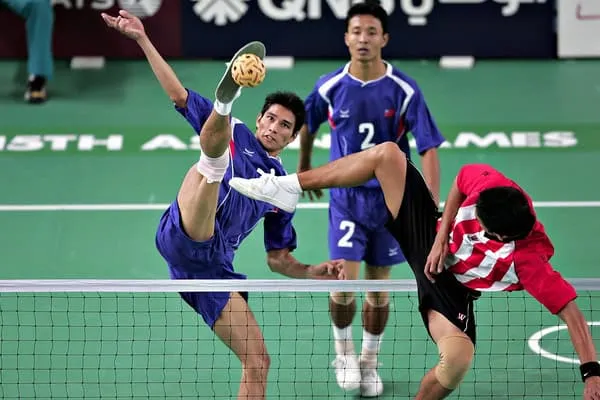

However, although these two games have much in common, like using the same ball, having similar roots in Southeast Asia, and incorporating elements of football handling, they still differ from each other in terms of purpose, rules of play, scoring system, and physical effort required. This problem is especially relevant because there is a tendency among those people who are unaware of these entertainments to confuse sepak takraw and chinlone. Incidentally, both can be viewed on the Melbet website as well as bet on. The thing is that both sepak takraw and chinlone games are viewed by people as being one and the same because they use the same ball.
Structural Differences
The basic difference is the mode of competition. In sepak takraw, the game is played in an adversarial way, with two teams each made up of three players playing against each other with the aim of hitting the ball down on the other side. In chinlone, the game is cooperative in nature and is played by six players who play in circles with the ball in the air.
As can be seen from above, the mode of the game determines all aspects of gameplay. In sepak takraw, the ball is the weapon, and in chinlone, the ball is a means of expression. The scoring systems reflect these opposing philosophies:
- Sepak takraw uses a rally-point system similar to volleyball, where each rally produces a point for one side; matches are best of three sets to 21 points.
- Chinlone uses a judged scoring system similar to gymnastics or figure skating, where panels evaluate technical difficulty, artistic expression, variety of techniques, and synchronization with musical accompaniment.
Another way to distinguish between the two is through the use of music and the total lack of music in sepak takraw. For chinlone, the show is timed by a live percussion group. For sepak takraw, there is no music at all; just a whistle from the referee.
Technical Skill Comparison
These are the fundamental kicks, which are the same for both karate and taekwondo. They include the inside kick, the outside kick, the knee kick, and the back kick. It is the application of these techniques that differs.
The important skills in sepak takraw are the overhead spike skill, which involves executing a bicycle kick move while sending the ball over the net, the block skill, where the foot or shin is used to parry an attacking move or spike, and the serve skill, which involves tossing and kicking to start a game. All these skills involve great power, speed, and coordination. Fans of these two games through the Melbet application platform would find it interesting to watch how a similar kicking move yields totally different results in the two games.
In the game of chinlone, the skills that earn you more points are deceptive hits (the ball is hit to give the illusion that it travels one way but ends up going another way), hits from behind the body (striking the ball using your legs by reaching behind your body), and prolonged juggles (hitting the ball 10 times, 20 times, or even 30 times consecutively).
The following comparison captures the core technical divergence:
- Sepak takraw values power, accuracy, and reactive speed;
- Chinlone values subtlety, variety, and aesthetic flow.
The best sepak takraw player will have a hard time competing in chinlone because there are some attributes needed in chinlone that cannot be developed through strength training. The best chinlone player will also fail in competing in sepak takraw because the sport requires aggressive and impact moves.
Physical Demands
Flexibility is very crucial in both sports, especially hip, hamstring, and ankle flexibility. In addition to balance and body coordination, the major difference lies in the type of energy system used.
The sepak takraw sport is very anaerobic in nature at some critical moments. The use of maximum effort in muscle recruitment occurs in less than one second. The recovery time between games is also short. The physical profile of an excellent sepak takraw player is that of a sprinter or a volleyball hitter: slender and explosive in nature.
On the other hand, the chinlone sport is primarily aerobic with short anaerobic bursts during the tricks. There is continuous movement by the central player for several minutes with occasional bursts of energy.
Training Divergence
Training methodologies become quite different from one another. An athlete, when young, if he joins sepak takraw, will be trained to jump, spike, block, and play matches competitively. An athlete, when young, if he joins the chinlone team, will train on his ball-handling alone, doing tricks, playing music, and circle coordination.
However, cross-training becomes feasible during the junior stages because the skills acquired in these sports are exchangeable. However, once they enter their competitive stage (teenage stage), specialization in one becomes the order of the day. This is due to the nature of the sport, which makes it difficult for the athlete to excel in both.
Like our Facebook Page here at NasiLemakTech.com for more news and in-depth reviews! Also, join our Facebook Group for insightful information and memes!
Subscribe to our YouTube channel too!