
















Remember about the attempt to levitate small objects at Laboratory of Thermodynamics in Emerging Technologies in Switzerland last year? This year, Japan has successfully levitated some objects in their lab; maybe it’s their way of opening the new year with style. On with progress of 2014!
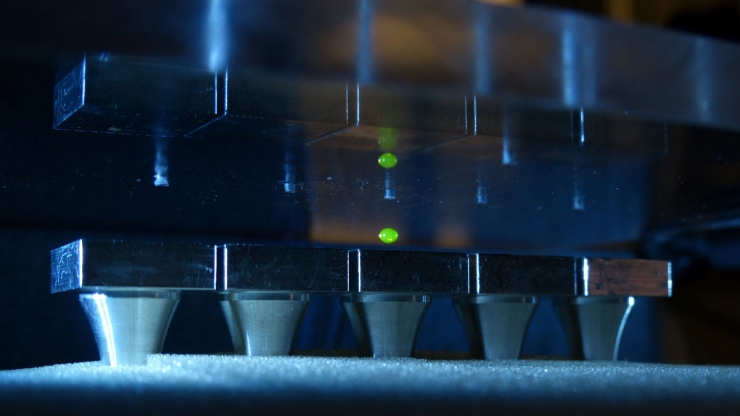
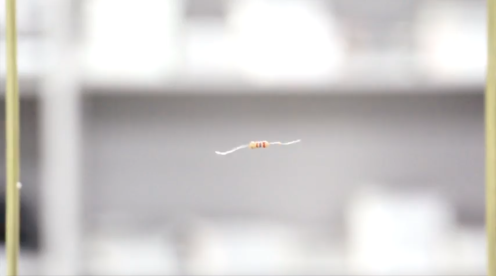
The theory behind this particular levitation is to use sound waves to maintain an object at a particular position in the air. Not only these scientists at the University of Tokyo levitate a certain test object but it works with any small objects such as a resistor or any small object that is within the range of the sound’s wavelength. But wait, not only does it hover but they could also manipulate the position of the object in space!
The idea of acoustic levitation has long been imagined and theorised but Japan do what they do best, ‘copy’ and improve. The idea is to use standing waves to send a wave that will hold it from going up and using it’s reflected wave to hold it from going down as you can see in this picture:
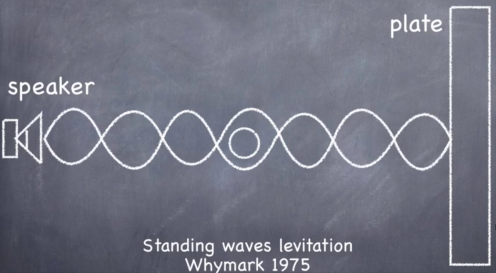
Then, they started to play with the position a bit on a single axis.
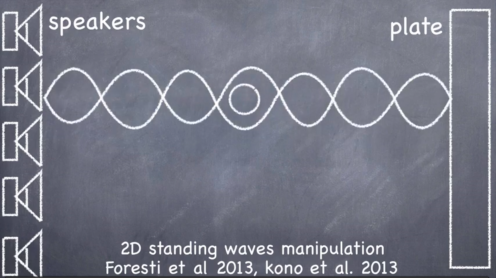
Then, what the Japanese did was instead of using place, they replace it with another array of speakers that allow them to not only manipulate the position in a restricted manner but dynamically adjust the wavelength and position of the standing waves.
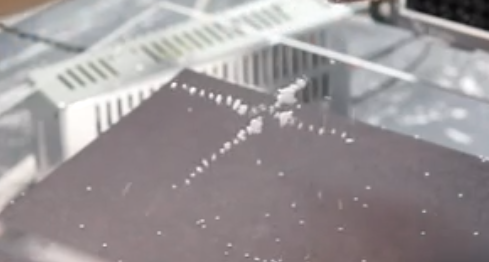
Here you can see the wave in it’s real world ,visible form.

According to Yoichi Ochiai, Takayuki Hoshi, and Jun Rekimoto in their research paper:
Our manipulation system has two original features. One is the direction of the ultrasound beam, which is arbitrary because the force acting toward its centre is also utilised. The other is the manipulation principle by which a localised standing wave is generated at an arbitrary position and moved three-dimensionally by opposed and ultrasonic phased arrays. We experimentally confirmed that various materials could be manipulated by our proposed method.
Acoustic levitation is one of the theories that made into the real world in practical form which the others such as quantum levitation using a super conductor is much less practical.
Via: Sploid, Gizmodo
Like our Facebook Page here at NasiLemakTech.com for more news and in-depth reviews! Also, join our Facebook Group for insightful information and memes!
Subscribe to our YouTube channel too!