




















These two smartphones have some intense rivalry. They were both announced on the same day, and they’re both within RM101 difference. However, their similarities start to end there. These two smartphones bring very different experience to the table. That’s why we’ve doing this comparison – the epic OPPO R9s vs. Samsung Galaxy A7 (2017)!
We’ve reviewed both the OPPO R9s and the Samsung Galaxy A7 (2017) too.
At the end of the day, the choice is yours. Both of these are great smartphones – but their differences will affect your user experience. And we’re here to tell you what are their differences.

Size and shape
It’s quite obvious, isn’t it? The size of these two smartphones is vastly different. Firstly, the Samsung Galaxy A7 (2017) is a 5.7-inch display, whereas the OPPO R9s has a 5.5-inch screen.
Obviously, screen size choice comes as a personal preference. But one thing is for sure – larger screens can result in a lower pixel density. Most of you might dismiss that extra 0.2-inch diagonal here is negligible, and I agree – but the fact holds true.
Other than the obvious screen size, the OPPO R9s is slimmer too. If both phones are completely naked, the OPPO R9s measures at only 6.6mm thin, whereas the Galaxy A7 (2017) measures at 7.9mm.
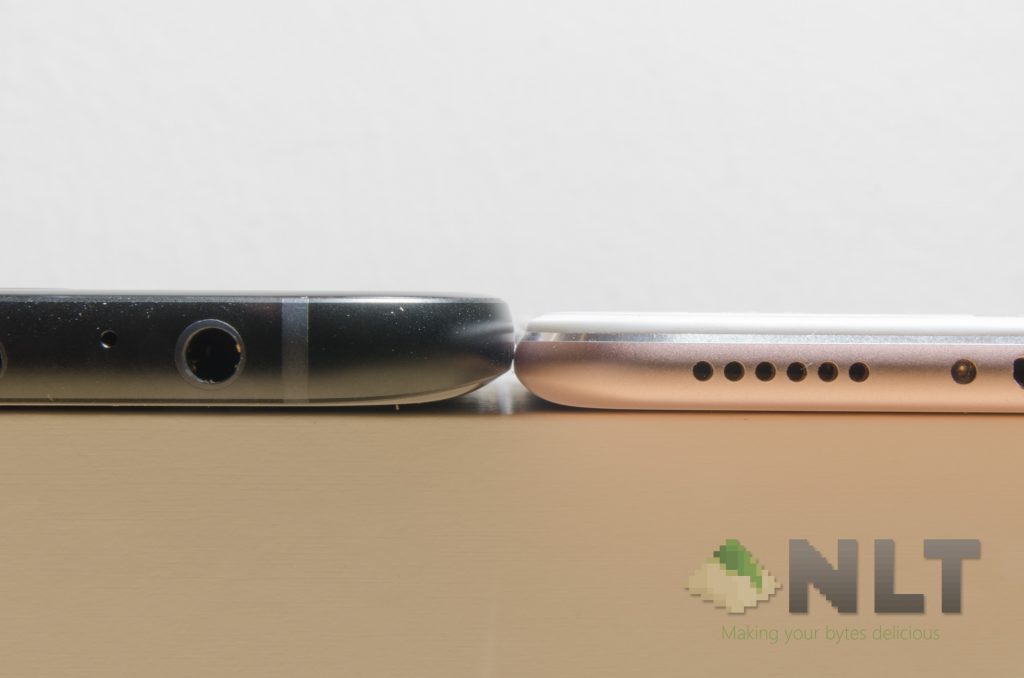
Since OPPO did include a TPU case for the R9s, I thought “hey, why not make use of it?“, and found out that it increased the thickness to about the Galaxy A7 (2017)’s thickness. Keep in mind, that this is with a case vs. without a case.

I have to give the first point here to the OPPO R9s here, just because its thickness is actually comfortable to use after putting the case on.
Camera
Being one of the most important aspects of a smartphone these days, these two smartphones sport a 16MP sensor each. Samsung used their own in-house sensor with the ID of SLSI_S5K3P8SX, whereas OPPO opted for Sony’s IMX398 – a customized sensor that is exclusive for OPPO only.
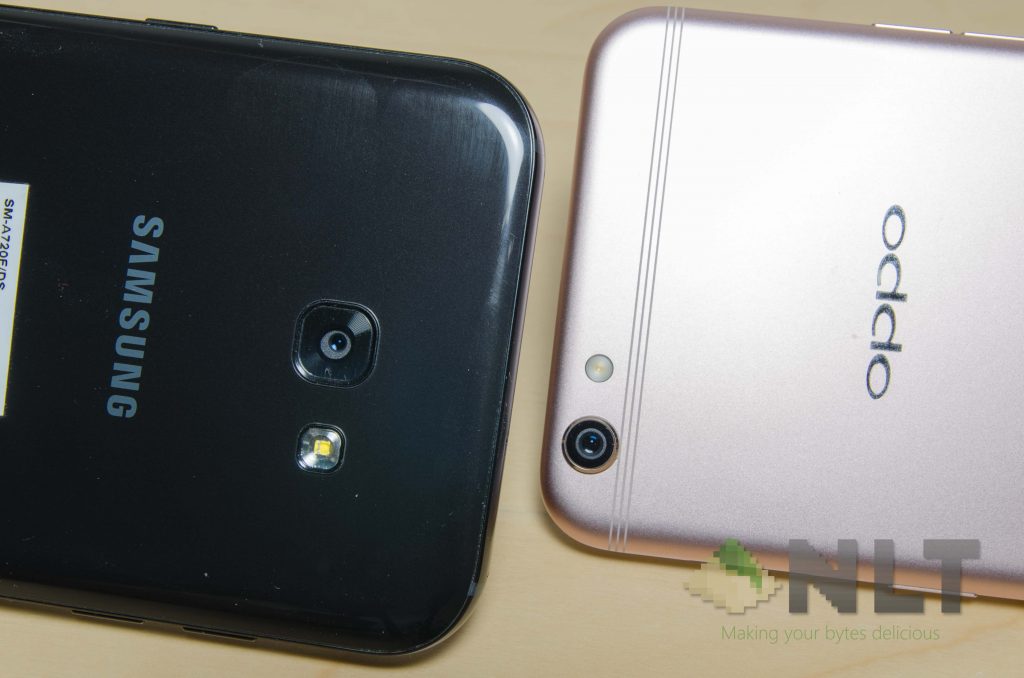
Both of them has quite a large aperture too – as the OPPO R9s has a f/1.7 aperture versus the Samsung Galaxy A7 (2017)’s smaller f/1.9 aperture. They can take some great photos overall throughout, but they obviously have their own set of differences. Take a look at the images below.


While taking outdoor shots, I can feel that the OPPO R9s does focus a lot faster than the Samsung Galaxy A7 (2017). However, OPPO R9s just couldn’t get the white balance right as it appears with a blue tint. Through my test, I also found out that the Samsung Galaxy A7 (2017) has a wide angle lens too – wider than the OPPO R9s. by quite a lot. Here’s another example showing the difference in wide angle.
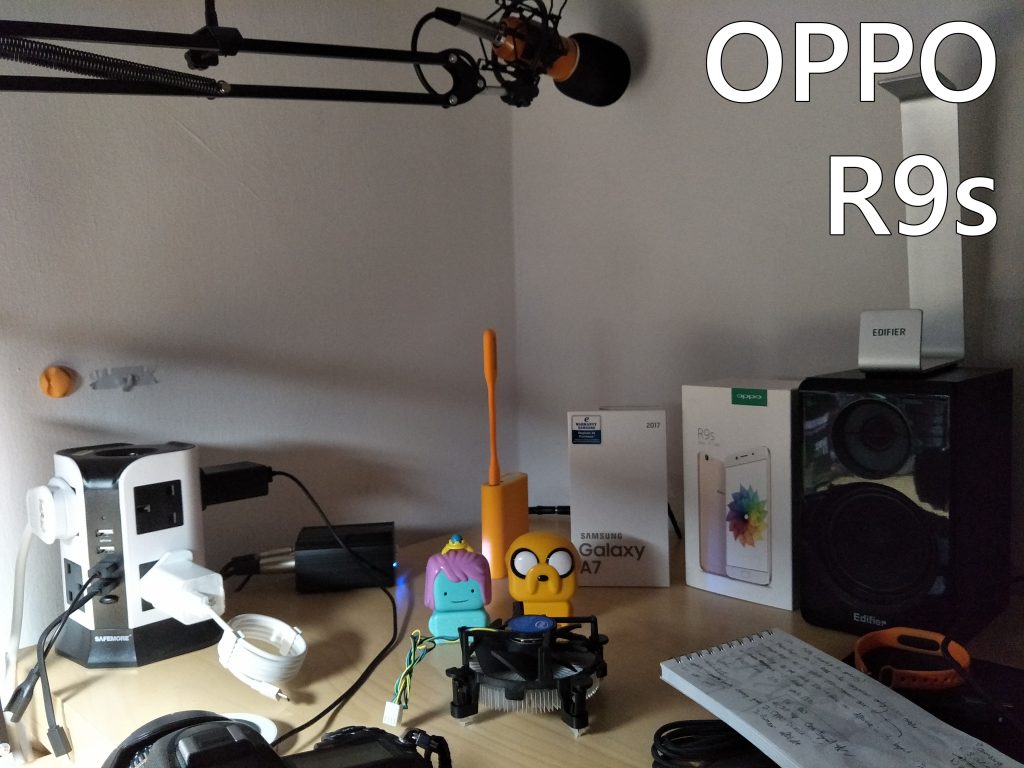

However, wider angle lens doesn’t mean clearer image. If the image is taken at the same distance and viewed at full crop (meaning at 100% zoom), the OPPO R9s obviously shows more details compared to the Galaxy A7 (2017).
Also, the Samsung Galaxy A7 (2017)’s slow live viewfinder and laggy shutter speed does plague its overall user experience. Pictures often turns out blurry compared to the OPPO R9s.
As for the selfie camera, this is where Samsung opted for the exact same camera sensor and the exact same f/1.9 aperture as well. OPPO R9s however, opted for what the OPPO F1s (we’ve reviewed it here) is already using.
For someone who doesn’t take selfies at all, I can only comment that the Samsung Galaxy A7 (2017)’s slow live viewfinder and laggy shutter speed does plague its selfie camera too. It might be fixable with a simple software update, but we’ll have to wait for Samsung to take action on that.
In this case, they both have their own pros and cons – but I’ll the OPPO R9s gets a slight edge in terms of pros vs. cons.
Fingerprint sensor
Let’s neglect the specifications in this aspect of comparison. Taking a look at firstly, the size of the fingerprint sensor on both phones. This is important, because the fingerprint sensor shape and size will ultimately dictate the amount of area it can work with your fingertip. It’s obvious that if a fingerprint that has a more effective contact area with your fingertip will yield a better fingerprint reading.
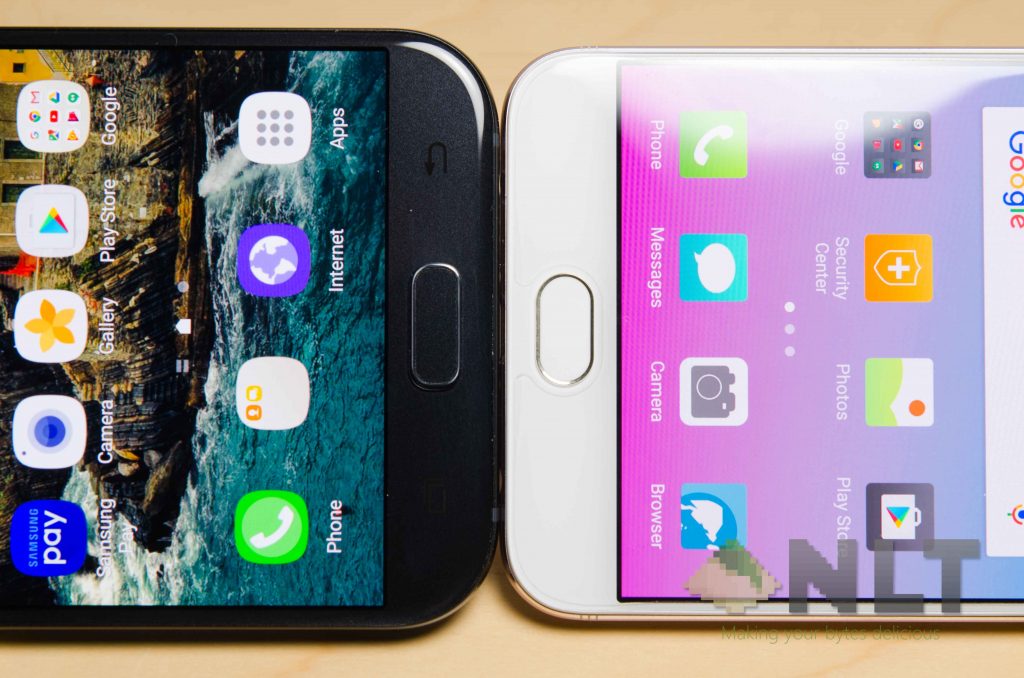
The Samsung Galaxy A7 (2017) uses a thinner and longer fingerprint sensor compared to the OPPO R9s. Throughout my tests, I did find out that the OPPO R9s’s fingerprint sensor is generally more accurate and faster than what the Galaxy A7 (2017) has to offer.
You can take a look at my fingerprint test for both the OPPO R9s and Galaxy A7 (2017) unboxing videos.
Of course, this can be due to the fact that their software is different – and that might be true. Different firmwares have different levels of security too. Furthermore, It will require some level of raw performance to decode and authenticate the fingerprint before proceeding to unlock the phone.
OPPO R9s obviously wins in terms of the fingerprint unlocking accuracy and speed. However, the fingerprint sensor pretty much serves as a compliment for a single purpose on this phone, but it does the job very well.
Another point for the OPPO R9s!
Performance
Both of these devices have hardware that is typically categorized as “mid-range”, but with current technology, they’re definitely great performers. Both of these devices uses 14nm FinFET transistors too (more details here). In this OPPO R9s vs. Samsung Galaxy A7 (2017) comparison, they’re actually both within the highly-praised category already – just because they’re using 14nm FinFET transistors.
In my opinion, these two devices are actually in between the mid-range to high-end category, too.
The OPPO R9s sports a more commonly-found Qualcomm Snapdragon 625 chipset with a Cortex-A53 octa-core processor at 2.0GHz. Samsung’s Galax A7 (2017) however, uses their own in-house chipset, the Exynos 7880 Octa with a Cortex-A53 octa-core processor at 1.9GHz.
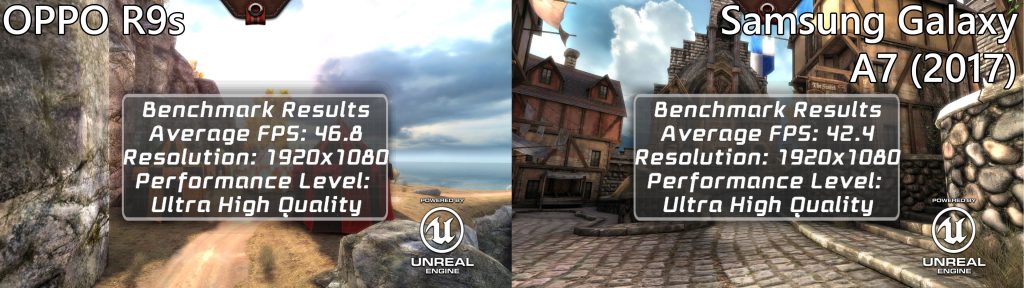
From our tests, I found out that the OPPO R9s does perform better than the Samsung Galaxy A7 (2017) all across the board. Epic Citadel, Vellamo, and PC Mark tell a very consistent story here too. The R9s just wrecks the Galaxy A7 (2017) across all benchmarks.
Vellamo scores are more towards the daily use case scenarios, and the scores here still continues to tell that the OPPO R9s does indeed have more raw performance.
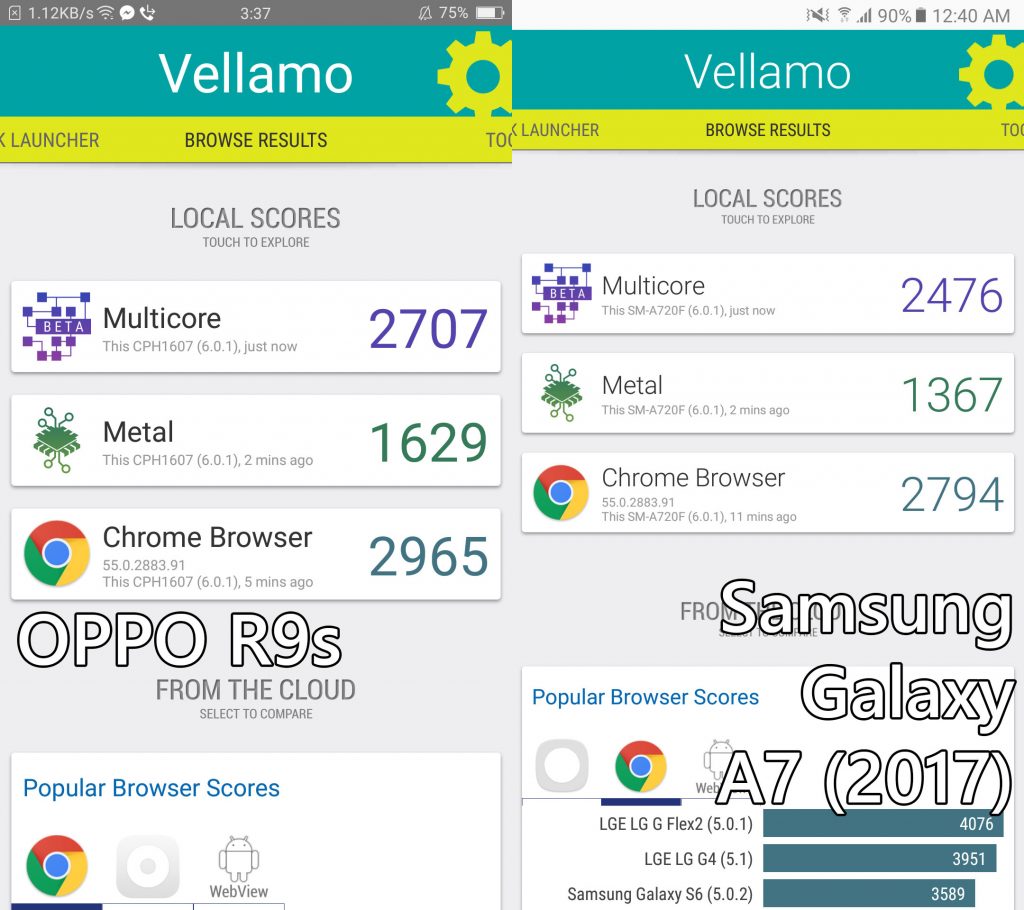
Though the significance of the performance difference is debatable, the numbers do not lie. I’ll have to give another point to the OPPO R9s.
With such performance, there must be a price to pay. And that leads us gracefully into the next section – the battery life.
Battery
As mentioned before, both of them uses 14nm FinFET transistors. That should help in terms of battery efficiency by a long run. However, nothing beats a battery longevity like having a massive battery capacity.
Samsung included a very generous 3,600mAh for the Galaxy A7 (2017), but there’s only a 3,010mAh on the OPPO R9s. Through PC Mark’s battery run test, it did show a significant difference in both their longevity.

That extra 590mAh is no joke – as it did propel the Samsung Galaxy A7 (2017) to have 3 hours more battery in PC Mark’s battery life test. That’s an insane difference if you ask me.
The obvious winner here is the Samsung Galaxy A7 (2017) for sure!
… but that’s not all!
The comparisons made here are purely based on the scores and image quality. While Samsung and OPPO’s own variant of the Android OS is up to the user’s preferences, I have to mention that Samsung does offer a lot more other features in their ecosystem, such as Samsung Pay. There’s even the Always On Display feature on the Samsung Galaxy A7 (2017) too.
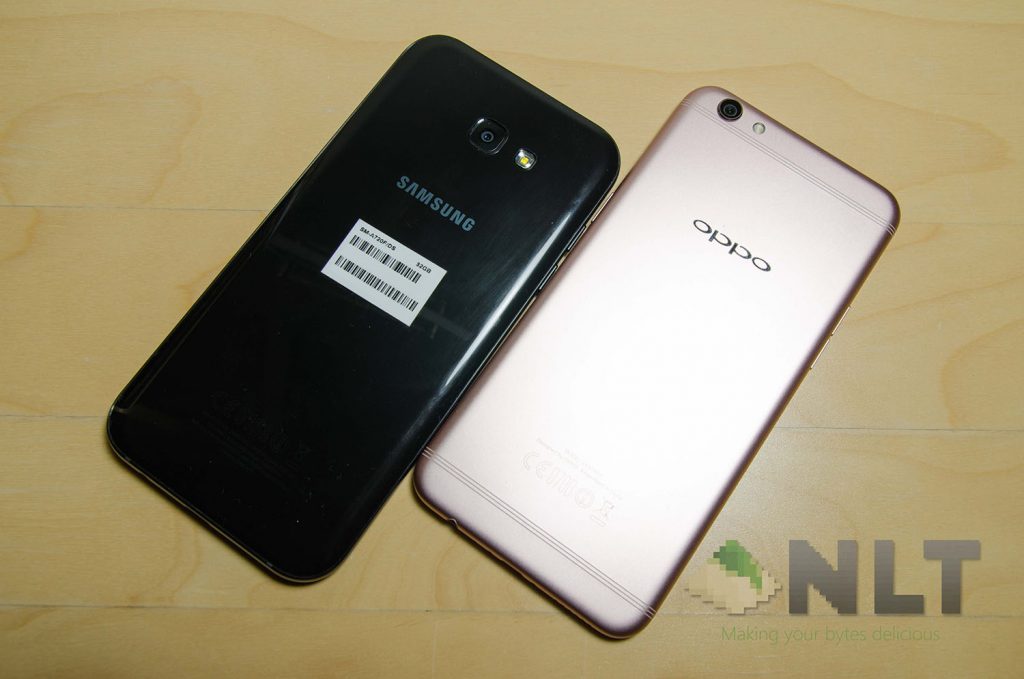
For a true dual-SIM device, the Galaxy A7 (2017) is the smartphone to buy since it offers dedicated slots for both SIM cards and a microSD card slot. OPPO R9s only has a single dedicated SIM card slot and another SIM/microSD combo slot.
Considering the entirety of both smartphones, it’s really difficult to say which one is the winner here. I feel that the OPPO R9s is catered more towards the lifestyle users who want a smartphone that is unique, whereas the Samsung Galaxy A7 (2017) is made for those who are productive on-the-go.
Ultimately, the choice is yours. Both of these are great smartphones – but their differences will affect your user experience.
Where to buy?
Lazada is the place to go!
Samsung Galaxy A7 (2017) @ RM 1,899 – Available in both Black Sky and Gold Sand, two more colors coming later.
OPPO R9s @ RM 1,798 – Available in Gold and Rose Gold, with the limited edition Valentine Red color available now.
That wraps up our OPPO R9s vs. Samsung Galaxy A7 (2017) comparison!
Which smartphone do you personally choose? Would you go for the Samsung Galaxy A7 (2017) or the OPPO R9s? They both have their own pros and cons – but at the end of the day, only one device will end up in your hands.
Let us know which device you chose or will choose. Post it down in the comments below – we would love to hear your opinion!
Like our Facebook Page here at NasiLemakTech.com for more news and in-depth reviews! Also, join our Facebook Group for insightful information and memes!
Subscribe to our YouTube channel too!