














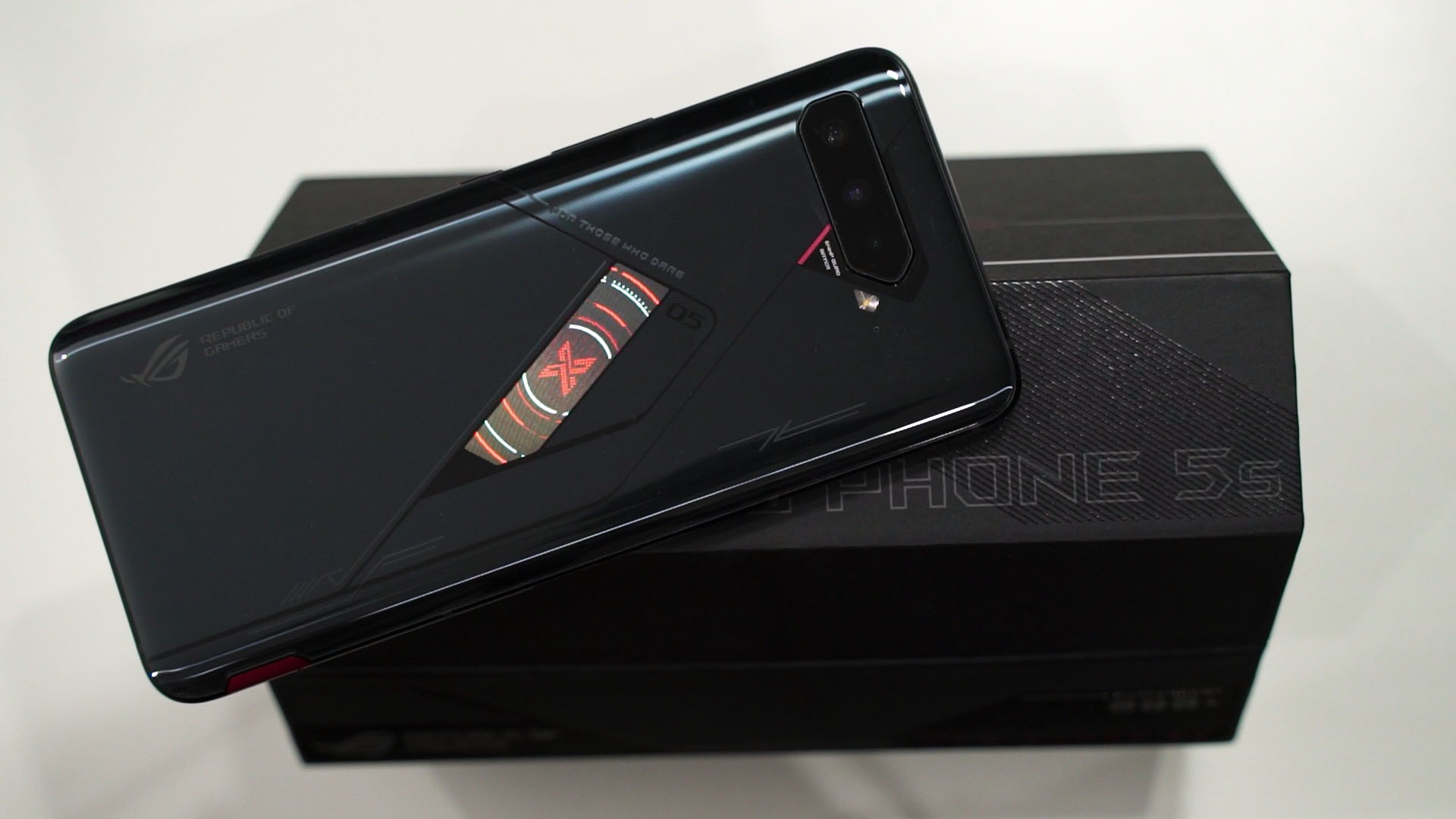

Since the first ROG Phone 4 years ago, Qualcomm also released a new “plus” variant of their flagship chipset of that particular year, touting even more performance. And it’s usually the ROG Phone series that make use of this “plus” variant of Qualcomm’s flagship Snapdragon chipset.
However, this year is different. We have the ROG Phone 5 series (review here) that utilizes the base version of Qualcomm’s flagship chipset – the Snapdragon 888. However, the Snapdragon 888 is known to be a heater of a chipset (as shown here), and my eyebrows raised at the fact that the Snapdragon 888+ actually exists, then quietly launched into the market, and is equipped in the ROG Phone 5s series of smartphones.
Since we have both the ROG Phone 5 (Snapdragon 888) and the ROG Phone 5s Pro (Snapdragon 888+) with us, we decided to compare and contrast what’s the difference between these two chipsets.
The only difference between these two phones is the chipset, by the way.
Benchmarks
We started off with 3DMark Wild Life. The results are… pretty close. But that’s only a short burst of performance.

What about in the long-run? So we tested with 3D Mark Wild Life stress test. It goes through 20 loops of the 3D Mark Wild Life back to back and see how a device sustains its level performance.

And to our surprise, the ROG Phone 5 with the Snapdragon 888 is ever so slightly better than the ROG Phone 5s Pro with the Snapdragon 888+.
In Geekbench 5 CPU test, the Snapdragon 888+ is surprisingly performing worse than the 888! But the GPU is slightly better.


Then for Antutu, we can see that the differences are clearer. The CPU on the Snapdragon 888 is better, but the GPU on the Snapdragon 888+ is better. The memory scores here are irrelevant since both devices have different RAM configurations.

What about gaming?
But benchmarks aside, we took both the ROG Phone 5 and ROG Phone 5s Pro and hopped into Genshin Impact and do the same things together, and see how both these phones perform in real-world gaming scenarios.
All I can say is, the performance difference between the scores is minimal and I just don’t think it’s enough of a difference to rave over the new Snapdragon 888+.

There are conspiracy theorists saying that Samsung sabotaged Qualcomm by making the Snapdragon inefficient. Those are serious accusations and I really want to see some proof.
But I honestly don’t think that’s the case because Samsung’s latest flagships – the Galaxy Z Fold3 and the Galaxy Z Flip3 – are both using the Snapdragon 888 chipsets too.

For all I can say, it seems like Qualcomm didn’t do proper QC or they messed up the implementation of their “Prime Core” that’s based on Arm’s Cortex-X1 design. It’s not the first time Qualcomm messed up and created a heating machine – look at the Snapdragon 810.
But that’s a topic for another day because it’s very in-depth.

I’d say ROG did a fantastic job (with asterisks) in terms of properly managing the heat coming out of the Snapdragon 888 and Snapdragon 888+ chipsets. There’s no screen dimming issue or extreme thermal throttling – it’s just very uncomfortable to touch.

By the way, I don’t know where to put this – if you want to check out the gaming performance of the ROG Phone 5s Pro alone – check out this video instead.
So… should you buy the ROG Phone 5s?
Everything else from the ROG Phone 5 review still applies to this ROG Phone 5s series, by the way. All the accessory compatibility and its features, they’re all still the same. Here’s a quick refresher for you.
Because of how few changes (only one, let’s be honest) there are between the ROG Phone 5 and the ROG Phone 5s series of smartphones – to the point that even the prices are the same – I’ll give the ROG Phone 5s Pro the same award.

Where to buy? (Affiliate links)
Like our Facebook Page here at NasiLemakTech.com for more news and in-depth reviews! Also, join our Facebook Group for insightful information and memes!
Subscribe to our YouTube channel too!